I've been trying to incorporate Google Reader into my repertoire of Internet tools. but apparently it doesn't get along too well with my work computer. So until I get that figured out, I hope to periodically post a few items of interest here on Sand Creek Almanac.
The Farmer as Natural Resource Professional
As a fish and/or wildlife manager, one of the first things one learns is that most of one's efforts to protect and maintain habitat and fish and wildlife populations are at the mercy of private land owners--farmers, forest product companies, developers, lake shore owners. Of these, farmers have influence over approximately 58 percent of the total land area in Minnesota. When I was in graduate school, we often saw examples of "farmer as bad guy" in land and watershed management: stream banks eroded by cattle, land tilled right up to the roadside, with no fencelines or other wildlife corridors, ditches washing topsoil and fertilizers into rivers. However, there always have been farmers who practice good land stewardship, and an increasing number are making the connection betweeen the health of the land, sustainable productivity, and wildlife habitat. The above link is about one such farmer, Kent Solberg. Solberg had a somewhat nontraditional route to farming; he grew up in the city, got a degree in wildlife management, and spent years working with various state and federal agencies as a wildlife manager. Now he and his wife raise dairy cattle, pork and eggs on carefully managed pasture on their farm in north central Minnesota. Listen to the linked podcast if you have time; it's about ten minutes long but very informative.
There is also a personal connection, which is why I was happy to find this story this morning. Solberg and The Hermit were buddies in graduate school, he was best man at our wedding, and I worked at the same office with him for several years. We haven't been in touch for a while, but I would like to visit their farm some day.
Choosing to live with less
In these tough economic times, there are a few people who are not feeling the pinch, since they have chosen to get by with what some would call poverty-level income. However, the lives they are living seem to be rich and fulfilling. I was inspired by these stories. And there's another personal connection; the barn dance I played at last week was called by Terrence Smith, who is featured in the article. His passion for music and dancing is contagious.
Showing posts with label environment. Show all posts
Showing posts with label environment. Show all posts
Monday, November 17, 2008

Tuesday, October 28, 2008
more thoughts on Vote Yes Minnesota
As Election Day approaches, debate over Minnesota's proposed Clean Water, Land, and Legacy Amendment has intensified. Dennis Anderson of the Minneapolis Star Tribune, who once wrote a scathing article about why arts should not be included in a dedicated funding amendment, offers a good discussion of how the amendment would work and rebuts some of the most common criticisms of the amendment.
One of the themes that appears over and over in letters to the editor opposing the amendment is that the outdoors, and the arts, are for special interest groups only, and these special interests should compete with other causes--schools, transportation, health care--for appropriations from the Legislature, and not create a source of dedicated funding just for hunters and theater-goers' pet projects.
Is our society really so distanced from nature, and from the arts, that they are now seen as just choices on a menu? Does a generation or so of us really think that the outdoors is only for those who are "into" outdoor recreation, and the arts are just another diversion like golf or NASCAR?
Our ecosystem, and art--essentially a witness to our humanity--are NOT special interests. We need them whether we consciously realize it or not. They are essential to our survival and our identity.
As I mentioned above, there was initially intense disagreement about putting the environment and the arts together on one amendment. Even now Anderson seems to dismiss the arts part only as something that was politically necessary to include. But the environment and the arts are not two separate entities, and most journalists covering this issue fail to realize this. Greg at The Dharma Blog posted eloquently on this topic back in February 2007, a year before the Legislature approved putting the amendment on the ballot. To sum it up:
It is interesting that this feeling, this "stillness" as Greg describes it, is increasingly being found to be vital to our health. Richard Louv, author of the bestseller Last Child in the Woods and founder of the Children and Nature Network, tracks an ever-growing list of research showing the mental and physical benefits of interaction with nature, particularly with children. Lists and links to research can be found on the Network's website. A quick Google search of "fine arts health" provided more links than I had time to look at. There is a growing industry of arts consultants who specialize in working with health care facilities to design environments that have been proven to promote healing in hospital patients.
Maybe if people were more connected with nature and the arts in the first place, the overall health of the population would improve. There would be less obesity, less chronic degenerative disease, less depression. This would lead to fewer medical procedures, fewer prescriptions, fewer hospital stays with their inherent risks, and greatly reduced health care costs. I can't think of a single person that would be opposed to that! The Clean Water, Land and Legacy Amendment could, in the long term, potentially generate more in health care savings than it takes in in revenue.
I sincerely hope this amendment gets passed, and that in addition to some desperately needed environmental restoration projects, and restoration of diminishing public support for the arts, a good portion of the money will be spent on initiatives that aim to reconnect people, especially children, with art and nature.
One of the themes that appears over and over in letters to the editor opposing the amendment is that the outdoors, and the arts, are for special interest groups only, and these special interests should compete with other causes--schools, transportation, health care--for appropriations from the Legislature, and not create a source of dedicated funding just for hunters and theater-goers' pet projects.
Is our society really so distanced from nature, and from the arts, that they are now seen as just choices on a menu? Does a generation or so of us really think that the outdoors is only for those who are "into" outdoor recreation, and the arts are just another diversion like golf or NASCAR?
Our ecosystem, and art--essentially a witness to our humanity--are NOT special interests. We need them whether we consciously realize it or not. They are essential to our survival and our identity.
As I mentioned above, there was initially intense disagreement about putting the environment and the arts together on one amendment. Even now Anderson seems to dismiss the arts part only as something that was politically necessary to include. But the environment and the arts are not two separate entities, and most journalists covering this issue fail to realize this. Greg at The Dharma Blog posted eloquently on this topic back in February 2007, a year before the Legislature approved putting the amendment on the ballot. To sum it up:
It has been useful for me to remind myself that the way I feel while standing before one of the Minneapolis Institute of Art's Van Goghs is not much different than the way I feel while paddling my canoe down the St. Croix River.
It is interesting that this feeling, this "stillness" as Greg describes it, is increasingly being found to be vital to our health. Richard Louv, author of the bestseller Last Child in the Woods and founder of the Children and Nature Network, tracks an ever-growing list of research showing the mental and physical benefits of interaction with nature, particularly with children. Lists and links to research can be found on the Network's website. A quick Google search of "fine arts health" provided more links than I had time to look at. There is a growing industry of arts consultants who specialize in working with health care facilities to design environments that have been proven to promote healing in hospital patients.
Maybe if people were more connected with nature and the arts in the first place, the overall health of the population would improve. There would be less obesity, less chronic degenerative disease, less depression. This would lead to fewer medical procedures, fewer prescriptions, fewer hospital stays with their inherent risks, and greatly reduced health care costs. I can't think of a single person that would be opposed to that! The Clean Water, Land and Legacy Amendment could, in the long term, potentially generate more in health care savings than it takes in in revenue.
I sincerely hope this amendment gets passed, and that in addition to some desperately needed environmental restoration projects, and restoration of diminishing public support for the arts, a good portion of the money will be spent on initiatives that aim to reconnect people, especially children, with art and nature.
Friday, October 03, 2008
an Aldo Leopold quote to ponder
"It would appear, in short, that the rudimentary grades of outdoor recreation consume their resource-base; the higher grades, at least to a degree, create their own satisfactions with little or no attrition of land or life. It is the expansion of transport without a corresponding growth of perception that threatens us with qualitative bankruptcy of the recreational process. Recreational development is a job not of building roads into lovely country, but of building receptivity into the still unlovely human mind."
from "Conservation Esthetic", date unknown
from "Conservation Esthetic", date unknown
Thursday, October 02, 2008
the prodigal cat, and other weirdness
Blue Flame is still alive and well. The kids lured him from underneath the cabin a couple of days ago. He had likely not ventured from that spot since he went missing a week and a half ago. He is in the cabin now, about five pounds lighter and I had to cut a massive cat dreadlock from his back. But he is still as sweet and stupid as ever.
There are frost advisories for tonight, but they are all to the south of here. Go figure. I covered up three tomato beds and one pepper/eggplant bed in the vain hopes that they will still produce a viable harvest. I need to give it up already.
I made the mistake of walking by the crabapple trees yesterday, their branches loaded with rosy red fruit, and I started thinking...maybe it's time I did a batch of jelly again. Or that liqueur. So I may be a kitchen warrior this weekend.
And my kitchen may finally get the change of venue in the next couple of weeks. The electrical inspector gave the okey-dokey today, so the first priority is insulating, then completing the outlets, then moving the fridge and workbench countertop and connecting the range and hood, and I'll be cooking in the new house! Right now it's a real pain, the cook shed is many steps away from the house, especially if it's raining. And I hate going off by myself to cook. Then again, going off by myself is nice sometimes. I get to listen to whatever music I want.
I had a huge spike in hits on my Site Meter today, due to a post that almost slipped away unnoticed about ATV's. Apparently it got noticed by someone who posted a link on an ATV group listserv, and I got a couple of comments. I will have more to say in a future post, but I couldn't help but notice what a defensive bunch they are. I never really got the answer I was seeking. Oh well, Dan from Payne Hollow provided some comic relief. Thanks.
Finally, I have gone political, as you can see from my sidebar. I listened to an Obama speech from LaCrosse, Wisconsin yesterday and it was electrifying. He spoke to everything I believe is wrong with this country, and what he would do about it. The best part was when he spoke about education, how he wanted results but didn't want the teachers to teach for the tests. He wants kids to learn art and music too. Amen! And as for the Vote Yes Minnesota, we have the chance to vote on a constitutional amendment that would add a 3/8ths percent sales tax devoted to clean water and outdoor and cultural heritage, with all the proper citizen oversight. How could that be a losing proposition? Those kinds of things just won't get funded otherwise.
There are frost advisories for tonight, but they are all to the south of here. Go figure. I covered up three tomato beds and one pepper/eggplant bed in the vain hopes that they will still produce a viable harvest. I need to give it up already.
I made the mistake of walking by the crabapple trees yesterday, their branches loaded with rosy red fruit, and I started thinking...maybe it's time I did a batch of jelly again. Or that liqueur. So I may be a kitchen warrior this weekend.
And my kitchen may finally get the change of venue in the next couple of weeks. The electrical inspector gave the okey-dokey today, so the first priority is insulating, then completing the outlets, then moving the fridge and workbench countertop and connecting the range and hood, and I'll be cooking in the new house! Right now it's a real pain, the cook shed is many steps away from the house, especially if it's raining. And I hate going off by myself to cook. Then again, going off by myself is nice sometimes. I get to listen to whatever music I want.
I had a huge spike in hits on my Site Meter today, due to a post that almost slipped away unnoticed about ATV's. Apparently it got noticed by someone who posted a link on an ATV group listserv, and I got a couple of comments. I will have more to say in a future post, but I couldn't help but notice what a defensive bunch they are. I never really got the answer I was seeking. Oh well, Dan from Payne Hollow provided some comic relief. Thanks.
Finally, I have gone political, as you can see from my sidebar. I listened to an Obama speech from LaCrosse, Wisconsin yesterday and it was electrifying. He spoke to everything I believe is wrong with this country, and what he would do about it. The best part was when he spoke about education, how he wanted results but didn't want the teachers to teach for the tests. He wants kids to learn art and music too. Amen! And as for the Vote Yes Minnesota, we have the chance to vote on a constitutional amendment that would add a 3/8ths percent sales tax devoted to clean water and outdoor and cultural heritage, with all the proper citizen oversight. How could that be a losing proposition? Those kinds of things just won't get funded otherwise.
Tuesday, September 30, 2008
My "Show Me The ATV Nature Writing Challenge"
I'm feeling feisty tonight. So I was just thinking, how many miles of trails and acres of land in our Minnesota State Forests are now open to all terrain vehicles, through a process that virtually ignored the input from wildlife and fisheries biologists?
And what chance does a walking ruffed grouse hunter have against those who pass him/her on a state forest trail on an ATV, leaving a cloud of smoke and a ruined day behind?
And how many of these ATV riders claim that "We enjoy getting out and seeing nature on our rides!"
So here is the challenge I have for you: Much of our nature writing heritage has come from people who have hiked and paddled the wilderness, developing a reverence and respect for the land in the silent moments of community. But if ATV riders get such a kick out of connecting with nature, should not some thought-provoking writing come out of those experiences as well? Would that not be some justification for the destruction of land that occurs when motorized recreation becomes the norm? Do ATV riders pause for contemplation as they roar through the old growth forest?
Please, anyone, if you have any links to nature writing by those who choose to experience nature in a gasoline powered off trail vehicle, especially in Minnesota, please let me know.
And by the way, this writing does not represent the opinion of any employer I may have at the present time. Really, it doesn't. Believe me.
P.S. Welcome ATV listservers! I understand you scour the Internet looking for anyone who may disagree with you, and then gang up on them. Well, sorry, that's not tolerated here. I have a thick skin, I can take it, but I will only keep comments that address what it is that I am asking for here, or that further an intelligent discourse. And, will one of you be so kind as to forward me the original message that was posted to your group? My address is on the sidebar. And by the way, you're making my blog a hotter commodity by boosting my hit count.
Cheers.
And what chance does a walking ruffed grouse hunter have against those who pass him/her on a state forest trail on an ATV, leaving a cloud of smoke and a ruined day behind?
And how many of these ATV riders claim that "We enjoy getting out and seeing nature on our rides!"
So here is the challenge I have for you: Much of our nature writing heritage has come from people who have hiked and paddled the wilderness, developing a reverence and respect for the land in the silent moments of community. But if ATV riders get such a kick out of connecting with nature, should not some thought-provoking writing come out of those experiences as well? Would that not be some justification for the destruction of land that occurs when motorized recreation becomes the norm? Do ATV riders pause for contemplation as they roar through the old growth forest?
Please, anyone, if you have any links to nature writing by those who choose to experience nature in a gasoline powered off trail vehicle, especially in Minnesota, please let me know.
And by the way, this writing does not represent the opinion of any employer I may have at the present time. Really, it doesn't. Believe me.
P.S. Welcome ATV listservers! I understand you scour the Internet looking for anyone who may disagree with you, and then gang up on them. Well, sorry, that's not tolerated here. I have a thick skin, I can take it, but I will only keep comments that address what it is that I am asking for here, or that further an intelligent discourse. And, will one of you be so kind as to forward me the original message that was posted to your group? My address is on the sidebar. And by the way, you're making my blog a hotter commodity by boosting my hit count.
Cheers.
Wednesday, February 27, 2008
Time away...
I just spent over 24 hours away from my family and my blog. I was about 90 miles away attending our biannual regional Fisheries work meeting, which turned out to be more interesting than my name for it suggests. We had a good mix of area office and hatchery updates, which was interesting considering two of the three hatcheries in our region sustained considerable damage from the August floods in southeastern Minnesota. And we had some very good research updates and invited speakers. My favorite was Paul Wotzka, a former hydrologist for the Minnesota Department of Agriculture, who was fired for testifying to the state Legislature about the dangers of atrazine, a commonly used and very profitable pesticide. For background info on the dangers of atrazine, please visit Tyrone Hayes' Web site. Think cancer, endocrine disruption, et cetera.
I am concerned about atrazine on a local level. Wotzka spoke about how quickly chemicals reached the groundwater in areas of karst topography. We have a slightly different kind of karst topography here, sandstone replacing limestone, but still the fast movement of rainfall into groundwater has been demonstrated. Not to mention the fact that atrazine occurs in rainfall, and has been found in Lake Harriet, a very urban water far from any corn fields. I don't live in a very agricultural area, but I did notice many more acres planted in corn this year. And does the atrazine rainfall reach me?
In Minnesota, we are experiencing an ethanol boom. Farmers are growing corn for higher prices, and ethanol plants are springing up everywhere under the (ahem. misguided.) promise that ethanol will solve our nation's dependence on foreign oil. So, since the year 2000, the number of acres treated with atrazine has steadily grown, farmers are taking acreage out of conservation programs like CRP to grow a suddenly profitable crop, while all the evidence shows that the production of ethanol shows little to no net gain in energy, not to mention soil erosion and pesticides getting into the water we drink.
I could go on and on about this. I think the rush towards ethanol is wrong on so many levels. Where does "doing with less" fit into the picture? All of the ATV's, snowmobiles, and overpowered boats are a luxury use of fuel that should be scrutinized.
I also roomed with Jean, my office secretary and the Best Office Professional In the World!, and maker of the best baked goodies (except for Dave our regional Project Administrator who makes a killer carrot cake!). I found out that she and I probably have a lot more in common than I ever thought. I just need to work on the State Fair award winning jams, jellies, and pickles part. :) Anyway, she is a real sweetheart, really knows how to enjoy life, and I hope she never retires! :)
But, I am glad to be home, humble as it is.

I am concerned about atrazine on a local level. Wotzka spoke about how quickly chemicals reached the groundwater in areas of karst topography. We have a slightly different kind of karst topography here, sandstone replacing limestone, but still the fast movement of rainfall into groundwater has been demonstrated. Not to mention the fact that atrazine occurs in rainfall, and has been found in Lake Harriet, a very urban water far from any corn fields. I don't live in a very agricultural area, but I did notice many more acres planted in corn this year. And does the atrazine rainfall reach me?
In Minnesota, we are experiencing an ethanol boom. Farmers are growing corn for higher prices, and ethanol plants are springing up everywhere under the (ahem. misguided.) promise that ethanol will solve our nation's dependence on foreign oil. So, since the year 2000, the number of acres treated with atrazine has steadily grown, farmers are taking acreage out of conservation programs like CRP to grow a suddenly profitable crop, while all the evidence shows that the production of ethanol shows little to no net gain in energy, not to mention soil erosion and pesticides getting into the water we drink.
I could go on and on about this. I think the rush towards ethanol is wrong on so many levels. Where does "doing with less" fit into the picture? All of the ATV's, snowmobiles, and overpowered boats are a luxury use of fuel that should be scrutinized.
I also roomed with Jean, my office secretary and the Best Office Professional In the World!, and maker of the best baked goodies (except for Dave our regional Project Administrator who makes a killer carrot cake!). I found out that she and I probably have a lot more in common than I ever thought. I just need to work on the State Fair award winning jams, jellies, and pickles part. :) Anyway, she is a real sweetheart, really knows how to enjoy life, and I hope she never retires! :)
But, I am glad to be home, humble as it is.

Sunday, February 24, 2008
The Wii paradox
There are those who hypothesize that kids don't get outdoors these days because they are too busy inside playing video games.
I had the chance to test that hypothesis this weekend. Give the kids a Wii, and equal access to an outdoor area, complete with a pond for skating, and access to cross country skis. Set an example, and see what they choose.
 Yes, this is Calvin. I only had to mention that I was going to try out my cross country skis, and he was right there. We had a good ski around the former horse pasture. When we came back, Starflower and Mr. Attitude were waiting for us at the pond.
Later, I was doing dishes in the cook shed, and I heard the kids heading out to the pond. As soon as I was finished washing dishes, I grabbed my skates and headed out there. I spent a glorious hour there, complete with snowball fights and everything. I even did a single toe loop-single toe loop combo, although I fell a few times trying it.
The paradox is, the kids had no reason to go outside, what with a new Wii and everything. But they did. Calvin chose twice, to go skiing and later to go skating.
So I really don't believe those who say that kids don't get outdoors these days simply because they choose to play video games instead. My children had the choice, and they chose the outdoors. I think every child who has access to a frozen pond, or stream, or woods, will go there if they can. I mean, there is so much more to discover outdoors, with real land to explore! My children are lucky. But I think about the neighborhood I grew up in, and how there were no wetlands, no streams, no wild forests to explore. So how are children supposed to connect to the land when they have no land to connect with?
I had the chance to test that hypothesis this weekend. Give the kids a Wii, and equal access to an outdoor area, complete with a pond for skating, and access to cross country skis. Set an example, and see what they choose.
 Yes, this is Calvin. I only had to mention that I was going to try out my cross country skis, and he was right there. We had a good ski around the former horse pasture. When we came back, Starflower and Mr. Attitude were waiting for us at the pond.
Later, I was doing dishes in the cook shed, and I heard the kids heading out to the pond. As soon as I was finished washing dishes, I grabbed my skates and headed out there. I spent a glorious hour there, complete with snowball fights and everything. I even did a single toe loop-single toe loop combo, although I fell a few times trying it.
The paradox is, the kids had no reason to go outside, what with a new Wii and everything. But they did. Calvin chose twice, to go skiing and later to go skating.
So I really don't believe those who say that kids don't get outdoors these days simply because they choose to play video games instead. My children had the choice, and they chose the outdoors. I think every child who has access to a frozen pond, or stream, or woods, will go there if they can. I mean, there is so much more to discover outdoors, with real land to explore! My children are lucky. But I think about the neighborhood I grew up in, and how there were no wetlands, no streams, no wild forests to explore. So how are children supposed to connect to the land when they have no land to connect with?
Thursday, July 19, 2007
another reason to like my Subaru
On the way home from work, in my Subaru of course (haven't picked up the Accord from brake surgery yet) I was listening to the Duluth independent public radio station. One syndicated program they carry was supported by Subaru. In the quasi commercial they are allowed on public radio, they said that Subaru plants are committed to zero contribution to landfills. Everything is reused or recycled, or so they say.
It's a step in the right direction. Although I'm sure they haven't factored in the eventual waste that parts of their cars will create (If in fact they ever die; I'm counting on the reports that Subarus are immortal!) I think it's good that a major manufacturer considers the waste stream that manufacturing creates, and makes efforts to eliminate it.
And I'm happy to have purchased a slightly used vehicle, not a new one. Not only for the monetary savings, but if I had purchased a new vehicle I would have contributed to the consumer demand that fuels the production of new vehicles, and the concomitant waste.
We considered a new Ford Escort hybrid; financing aside, we rejected it for the fact that hybrids haven't been widely used in cold climates like here, and that they really don't get significantly greater gas mileage than the car we bought, and that buying a used conventional vehicle trumps buying a new hybrid, material wise. And, our dear trusted mechanic in the nearest town might not be able to work on a hybrid, although I'm sure he'd give his best at it.
It's a step in the right direction. Although I'm sure they haven't factored in the eventual waste that parts of their cars will create (If in fact they ever die; I'm counting on the reports that Subarus are immortal!) I think it's good that a major manufacturer considers the waste stream that manufacturing creates, and makes efforts to eliminate it.
And I'm happy to have purchased a slightly used vehicle, not a new one. Not only for the monetary savings, but if I had purchased a new vehicle I would have contributed to the consumer demand that fuels the production of new vehicles, and the concomitant waste.
We considered a new Ford Escort hybrid; financing aside, we rejected it for the fact that hybrids haven't been widely used in cold climates like here, and that they really don't get significantly greater gas mileage than the car we bought, and that buying a used conventional vehicle trumps buying a new hybrid, material wise. And, our dear trusted mechanic in the nearest town might not be able to work on a hybrid, although I'm sure he'd give his best at it.
Thursday, January 18, 2007
the aftermath

The first thought that came into my mind was, "It doesn't look quite as bad as I expected." Really. They left a few trees standing, they followed property lines, and this is the extent of how my view has been altered. You can't even see it from the new house.
But saying "It really doesn't look that bad" is like attending the wake of a friend that's been brutally murdered, staring at the body in the casket, and saying "My, the undertaker did such a lovely job!"
It used to all look like the extreme left side of the photo. The foreground is the shrub swamp, a haven for sedge wrens and song sparrows and bitterns in the summer. The aspen woods in the background are what was cut. It would have looked a lot worse if we had been foolish enough to grant an easement for the logger to build a road across the swamp.
Ah well, this is but a tiny paper cut (unintentional pun) compared to the cancer of destruction we humans have brought upon the planet. But paper cuts hurt, too.
A while after I wrote the first draft of this post, I went outside and heard the hooting of a barred owl, coming from somewhere in my woods. Which reminds me, The Hermit told me last night he had a dream, kind of like Hitchcock's "The Birds", except The Birds were great gray owls getting revenge on the loggers. After the carnage, he said, the owls roosted in our trees by the hundreds. I guess our little woods is a refuge. I like it that way.
Monday, January 15, 2007
the sound of violence
I hate to sound dramatic. Maybe it's this relatively weak cold snap that has me in a somber mood, but more likely it's the sound of logging equipment working over 48 hours straight now, all day and night Sunday and today. As I mentioned before, a parcel of land nearly adjoining mine is being logged. Not only that, the last remnant standing trees on tax forfeited land two miles south of here are also being logged. The clearcutting can now be seen from the road in the latter logging.
The incessant whine of the cutters and chippers and shredders penetrated my dreams last night. Yes, they're that close, I can hear them inside the house. I dreamed over and over that I looked out and the view I knew and loved was completely gone. I even double checked when I woke up for real, just to make sure the trees across the swamp were still there. Now, strictly following property lines, they should not log anything directly across the swamp from the new house, and there should be a thin buffer protecting the view where the logged land adjoins the neighbor's land to the south. But how can logging machines see property lines in the dark? I am still concerned.
But I don't think my dreams last night were entirely about my pretty view; Nature, after all, has a way of taking care of those things in swift and unpredicatable ways (remember the Boundary Waters blowdown of 1999) and I should not be selfish enough to demand that my particular view remain intact. Rather, I think my dream represented my fears about the bigger picture: losing the natural world that I love. Whether it is lost bit by bit to development, or in a bigger way by human-induced climate change, or by extraction-based practices such as clearcut logging, I am scared that the landscape I love is disappearing. In the case of logging, they say it is a renewable resource, that it will grow back. But when they shred every little bit of wood and leave nothing to the soil but tread marks, will it?
I told The Hermit tonight, if I didn't have kids that depended on me, I just might go out and confront the monster and tell it what I think of its greedy, short-sighted practices. But what I would do might be classified as "eco terrorism", which carries with it harsher sentences than would the assault and murder of a fellow human being. Even if I didn't harm a single human soul. Is it wrong to protect, or protest against the destruction of something I love if that something is not human?
I hear more than the whine of the machines. I hear the cries of a thousand trees as they die a violent death. Excuse me for being dramatic.
The incessant whine of the cutters and chippers and shredders penetrated my dreams last night. Yes, they're that close, I can hear them inside the house. I dreamed over and over that I looked out and the view I knew and loved was completely gone. I even double checked when I woke up for real, just to make sure the trees across the swamp were still there. Now, strictly following property lines, they should not log anything directly across the swamp from the new house, and there should be a thin buffer protecting the view where the logged land adjoins the neighbor's land to the south. But how can logging machines see property lines in the dark? I am still concerned.
But I don't think my dreams last night were entirely about my pretty view; Nature, after all, has a way of taking care of those things in swift and unpredicatable ways (remember the Boundary Waters blowdown of 1999) and I should not be selfish enough to demand that my particular view remain intact. Rather, I think my dream represented my fears about the bigger picture: losing the natural world that I love. Whether it is lost bit by bit to development, or in a bigger way by human-induced climate change, or by extraction-based practices such as clearcut logging, I am scared that the landscape I love is disappearing. In the case of logging, they say it is a renewable resource, that it will grow back. But when they shred every little bit of wood and leave nothing to the soil but tread marks, will it?
I told The Hermit tonight, if I didn't have kids that depended on me, I just might go out and confront the monster and tell it what I think of its greedy, short-sighted practices. But what I would do might be classified as "eco terrorism", which carries with it harsher sentences than would the assault and murder of a fellow human being. Even if I didn't harm a single human soul. Is it wrong to protect, or protest against the destruction of something I love if that something is not human?
I hear more than the whine of the machines. I hear the cries of a thousand trees as they die a violent death. Excuse me for being dramatic.
Thursday, January 04, 2007
log-a-thon
It is strangely quiet outside now, at 7 pm. Usually in the winter 7 pm is always a quiet time, but last night it was not. The air was ringing with the whining, humming sound of logging equipment. It went on for over 24 hours straight; loggers have so much invested in their equipment that when they get a good sale they can't afford to run fewer hours.
A parcel of land that includes a forty acre square that is kitty corner from ours on the southeast is being logged. When all is said and done, part of the view across my swamp will be altered considerably. And 120 acres will be trampled, cut over, and left to new succession. I should not be so concerned; it's just third or fourth growth aspen, which is regularly cut on a thirty year rotation around here. It will grow back, and ruffed grouse thrive in early succession aspen forest. The Hermit even earns his paycheck now encouraging land managers to manage for early succession aspen for ruffed grouse. It's what a certain group of hunters want.
I'm all for the local person making a living off logging. However, I can't help but think this sale-driven model of forestry is short sighted and dangerous. Far too much of the public forest land around here is managed for aspen, cut on a thirty year rotation, at the cost of diverse forest habitat. Sure, a few species might thrive in early growth aspen, but so many others, which are declining in numbers, require a mixed hardwood/conifer landscape with varying degrees of maturity. The county administers the majority of forest lands around here, most of it tax-forfeited since the 1930's, when people gave up on this area as farm land. But the county, in my opinion, lacks vision in managing this valuable resource; if it benefits a logger in the short term, it's good business. Never mind that other low impact logging models have shown good promise elsewhere.
Where is this timber going? Minnesota's timber industry has seen a slump as of late, so most likely it will go to foreign-owned mills in Duluth and Cloquet to be made into specialty high-gloss magazine paper. Great. Just what we need to see more of!
I knew this was coming. The logger who is doing the work stopped by a couple months ago, to ask if we would be willing to sell an access easement across the southern boundary of our land. This would have meant clearing at least a 15' wide road across high land, plus filling in that width of wetland 500' across, not to mention us having to listen to logging trucks driving across it. That in itself meant no thanks, but I detected a certain unscrupulousness on the part of the logger. He never gave us a name or phone number where he could be contacted with questions. Furthermore, he said that if we refuse, he could get the county to force an access across our property. Never mind that he had reasonable access from a county forest road to the south. I think his motive was to log the land, then sell it for deer hunting property "with deeded access". If he wasn't willing to be up front with us about this, then no thanks.
The management of the land, our only and greatest resource, is left to people like this.
Oh well, it's just trees. If there are any rare species there, they will most likely be driven onto our land. More birds for me!
A parcel of land that includes a forty acre square that is kitty corner from ours on the southeast is being logged. When all is said and done, part of the view across my swamp will be altered considerably. And 120 acres will be trampled, cut over, and left to new succession. I should not be so concerned; it's just third or fourth growth aspen, which is regularly cut on a thirty year rotation around here. It will grow back, and ruffed grouse thrive in early succession aspen forest. The Hermit even earns his paycheck now encouraging land managers to manage for early succession aspen for ruffed grouse. It's what a certain group of hunters want.
I'm all for the local person making a living off logging. However, I can't help but think this sale-driven model of forestry is short sighted and dangerous. Far too much of the public forest land around here is managed for aspen, cut on a thirty year rotation, at the cost of diverse forest habitat. Sure, a few species might thrive in early growth aspen, but so many others, which are declining in numbers, require a mixed hardwood/conifer landscape with varying degrees of maturity. The county administers the majority of forest lands around here, most of it tax-forfeited since the 1930's, when people gave up on this area as farm land. But the county, in my opinion, lacks vision in managing this valuable resource; if it benefits a logger in the short term, it's good business. Never mind that other low impact logging models have shown good promise elsewhere.
Where is this timber going? Minnesota's timber industry has seen a slump as of late, so most likely it will go to foreign-owned mills in Duluth and Cloquet to be made into specialty high-gloss magazine paper. Great. Just what we need to see more of!
I knew this was coming. The logger who is doing the work stopped by a couple months ago, to ask if we would be willing to sell an access easement across the southern boundary of our land. This would have meant clearing at least a 15' wide road across high land, plus filling in that width of wetland 500' across, not to mention us having to listen to logging trucks driving across it. That in itself meant no thanks, but I detected a certain unscrupulousness on the part of the logger. He never gave us a name or phone number where he could be contacted with questions. Furthermore, he said that if we refuse, he could get the county to force an access across our property. Never mind that he had reasonable access from a county forest road to the south. I think his motive was to log the land, then sell it for deer hunting property "with deeded access". If he wasn't willing to be up front with us about this, then no thanks.
The management of the land, our only and greatest resource, is left to people like this.
Oh well, it's just trees. If there are any rare species there, they will most likely be driven onto our land. More birds for me!
Sunday, August 06, 2006
A walk in Sand Creek
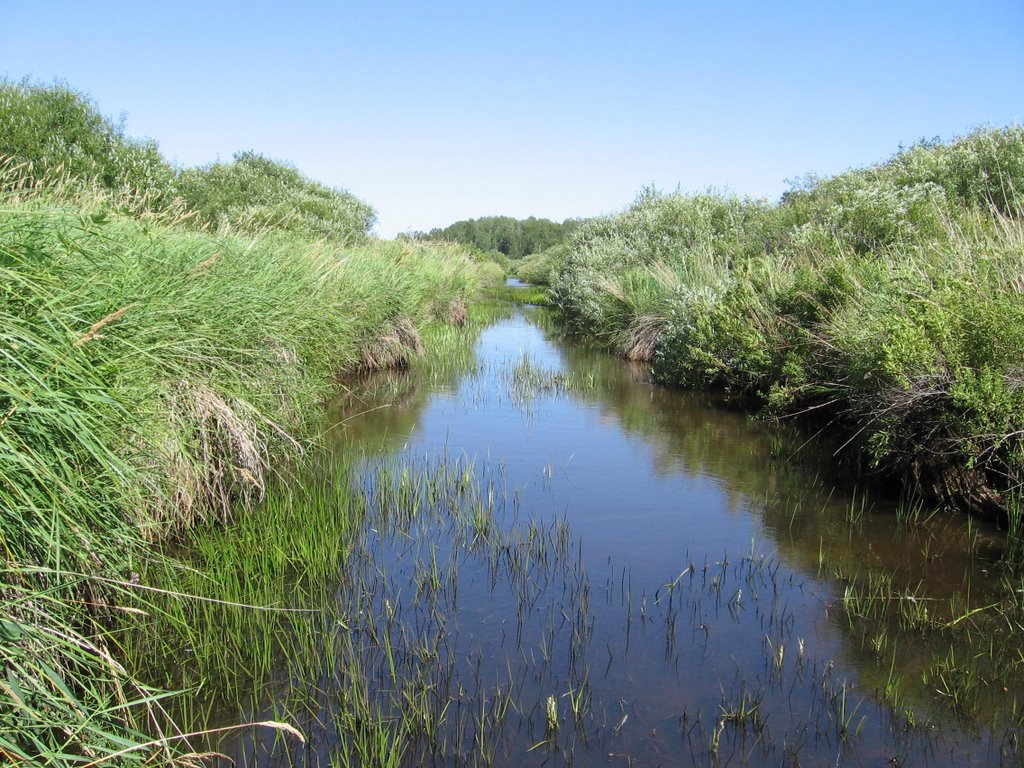
For being the title feature of this blog, you would think that Sand Creek would be a regular feature here. As it is, I have rarely mentioned or photographed this water, this connection to the St. Croix and Mississippi and Gulf of Mexico. Why do I not devote more blog space to Sand Creek?
For one thing, as evidenced in the above photo, Sand Creek is not very photogenic. There are no waterfalls, no rapids, no crystal blue shimmering pools. Sand Creek is a ditch. Really. It is still legally considered a county ditch although I know of no agricultural connections to it in the entire watershed. The natural watercourse was straightened in 1918, a time when speculators were trying to entice farmers to the logged-off land here. Straightened creeks are not happy creeks; they yearn to meander freely. Yet Sand Creek adapted better than most, soaking up flow from numerous springs in the area and creating habitat that supported native brook trout within the ditch banks.
Another reason is that Sand Creek is not very accessible. To get to the creek today I walked through the horse pasture, out the back gate, through a tangle of alder and willow with stinging nettle and thistle here and there, up over a steep former railroad crossing, down to the water which is heavily guarded by more alder and willow. I could have walked out to the road, taken a little access driveway on the other side of the creek, walked along the north bank a ways to where low grasses grow up to the stream bank. But I favored the direct route, through the brush.

It was an easy walk as far as streams go; no slippery boulders, very slow current, no deep mucky pools. There was the occasional remains of an old beaver dam, which gave the benefit of diversity; where there was an old dam, the stream narrowed and gained velocity, carving a pool directly below. The substrate was mostly sand, with some crunchy gravel areas which provide good spawning habitat for brook trout. The last time my coworkers shocked this stretch of stream, they found a few adult brookies. Today they were probably in the shady areas along the right side of the picture.
Today's walk, however, was for a deeper reason than mere blog fodder. I wanted to wade the creek, experience it close hand, so I could better try to understand a disturbing trend I've witnessed the last year or two: the water is getting more cloudy. Three years ago, the first spring we lived here, I walked the north creek bank and could look through the water and see brook trout redds (nests) on the gravel bottom of the creek. The water, although brown-colored from tannic acid, which is produced naturally in soft water swamps, was very clear. This year, during spring runoff and a period of base groundwater flow from extreme drought, the water has remained distinctly cloudy.

It should not look like this. I should be able to see the bottom here. Somewhere upstream, sediment is washing into the creek. Looking at the land ownership and use, I'm guessing that some logging took place in the last two years on private land, and the loggers did not follow Best Management Practices, which would be applied on public land, to avoid impacts to the stream. Or it could have been removal of a large beaver dam, but the effect of that would not have lasted as long as this has been happening. I was noticing the turbidity as early as last year.

This is what it should look like. The Hermit and I took a ride today to a road crossing about a mile upstream, then to one maybe five stream miles upstream. This is the latter; the water is brown, but distinctly clear, much clearer than where Sand Creek flows through our land. So whatever it is that's causing the turbidity is happening a few miles upstream, below the upper road crossing.
I can't let this sit. I am concerned about the effects on the few brook trout that inhabit the stream; they are sight feeders, they need cold, clear water to survive. Excessive sediment in the water will choke their spawning areas, cause water temperatures to rise to lethal levels for trout, and make it difficult for trout to find food.
I work for the very state agency that is responsible for the stewardship of Sand Creek, a designated trout stream. I am going to bring this up to my supervisor tomorrow, although I'm not very optimistic about a prompt response. But I will persist; this is my home watershed, this is a creek that someone has to care about, this is a creek that I care very much about. It deserves better than to be suffocated by bad land management.
Tuesday, July 25, 2006
reading material
I took some lovely pictures last night and this morning, but I have what is looking like a very long meeting to attend today and won't be able to get them posted until later. In the meantime, for a good read, check out James Howard Kunstler's latest essay, The Twilight of Lumpenleisure. It's a bit long, but it eloquently and poignantly describes the apex and decline of suburbia and middle class affluence in America. He especially takes on gasoline-powered forms of recreation that I have serious issues with. And, stay with it to the end, the last paragraph offers a twist, a glimpse of hope, a world that I would love to see for my children.
Wednesday, May 18, 2005
Recreation, land ethic, and choice
Disclaimer (cover my arse): The following statements are my personal views alone, and do not necessarily represent the position of any employer, past or present.
In any activity in one's life, from providing the basic necessities to seeking fulfillment and pleasure, one has a moral responsibility to question whether one's methods and choices are adversely affecting others in the land community, and to make choices that prevent undue harm. By the land community I mean all who dwell in and on the land and waters, human and nonhuman alike, living and non living. Aldo Leopold in his essay "The Land Ethic" describes this type of community:
We cannot avoid doing some harm while meeting our basic needs for survival, although we can and must make choices that are the least harmful. Our recreation, however, is a complete matter of choice, and we can choose, in fact if we believe in a land ethic we have the moral obligation to choose, forms of recreation that have the least impact on the land community. It is arrogant and self centered to do otherwise.
All terrain vehicles have known impacts to the land. One rider, driving once through previously undisturbed vegetated land, will at the minimum:
I have nothing against the responsible use of all terrain vehicles as part of farm or land management work, or by those who have a genuine disability who need to access certain areas and have considered the ramifications thoughtfully. But these are by far the exception to the use patterns you see today. Most use is purely recreational.
Does this sound like a form of recreation that is compatible with a land ethic?
Follow the money. It's just industrialized, corporate sponsored, mechanized, mass marketed land rape, catering to the irresponsible, self centered "me first" generation.
In any activity in one's life, from providing the basic necessities to seeking fulfillment and pleasure, one has a moral responsibility to question whether one's methods and choices are adversely affecting others in the land community, and to make choices that prevent undue harm. By the land community I mean all who dwell in and on the land and waters, human and nonhuman alike, living and non living. Aldo Leopold in his essay "The Land Ethic" describes this type of community:
The land ethic simply enlarges the boundaries of the community to include soils, waters, plants, and animals, or collectively: the land...A land ethic of course cannot prevent the alteration, management, and use of these 'resources', but it does affirm their right to continued existence, and, at least in spots, their continued existence in a natural state.Jesus had a command: Do unto others as you would have them do unto you. Wiccans have a similar code: As it harm none, do as ye will.
In short, a land ethic changes the role of Homo sapiens from conqueror of the land-community to plain member and citizen of it. It implies respect for his fellow members, and also respect for the community as such.
We cannot avoid doing some harm while meeting our basic needs for survival, although we can and must make choices that are the least harmful. Our recreation, however, is a complete matter of choice, and we can choose, in fact if we believe in a land ethic we have the moral obligation to choose, forms of recreation that have the least impact on the land community. It is arrogant and self centered to do otherwise.
All terrain vehicles have known impacts to the land. One rider, driving once through previously undisturbed vegetated land, will at the minimum:
- Injure and uproot vegetation
- Compact soil, disrupting aeration and habitat of microflora and fauna
- Create noise enough to disturb wildlife
- Leave a trail of gas fumes
- By discretionary consumption of gasoline , give tacit support to the military machine and domestic habitat destruction necessary to support our nation's level of fossil fuel consumption
Off-road use of vehicles can present serious and special problems of impact on the environment and incompatibility with other users of the land. Experience has shown that off-road use of vehicles may result in one or more of the following effects:
All vehicles:
- Physical soil damage, often readily visible, resulting in:
a. Erosion, causing soil loss and damage to stream banks, streams, and fish habitat;
b. Soil compaction and serious adverse impact on flora and its regeneration; and
c. Degradation of trails, including rutting and breakdown of trail edges.- Disruption of wildlife breeding and nesting habitats, especially of vulnerable species, resulting in loss of young;
- Disturbance of wildlife, leading to weakened physical condition, death, and possible extinction of some species;
- Damage to archaeological, scientific, historical and other significant sites, and damage to natural features, sometimes with irreversible effects, especially on rare features of interest for scientific study;
- Facilitation of illegal hunting fishing and the talking of game and non-game wildlife;
- Danger to the safety of other land users because of vehicle speed, steep terrain, sharp curves, slippery or unstable trail surfaces, and/or limited visibility; and
- Competition with other land users: vehicle operators, with their increased mobility, generally use a greater quantity of scarce land per recreational user.
Motorized vehicles:
- Introduction of air and water pollution to areas presently removed from any such sources;
- Excessive noise, which, in close proximity, may result in physiological effects on animals and humans, or may induce anxiety, altering animal behavior patterns, and which, in most circumstances, seriously degrades the solitude of wild areas for other users;
- Litter: by virtue of mechanization, operators of vehicles carry more gear, with potential to leave more litter;
- Vandalism: motorized ease of access is often coupled with increase of acts of vandalism on public and private property; and
- Fire: illegally or improperly operated vehicles can often create a fire hazard on public or private lands.
I have nothing against the responsible use of all terrain vehicles as part of farm or land management work, or by those who have a genuine disability who need to access certain areas and have considered the ramifications thoughtfully. But these are by far the exception to the use patterns you see today. Most use is purely recreational.
Does this sound like a form of recreation that is compatible with a land ethic?
Follow the money. It's just industrialized, corporate sponsored, mechanized, mass marketed land rape, catering to the irresponsible, self centered "me first" generation.
Subscribe to:
Posts (Atom)